
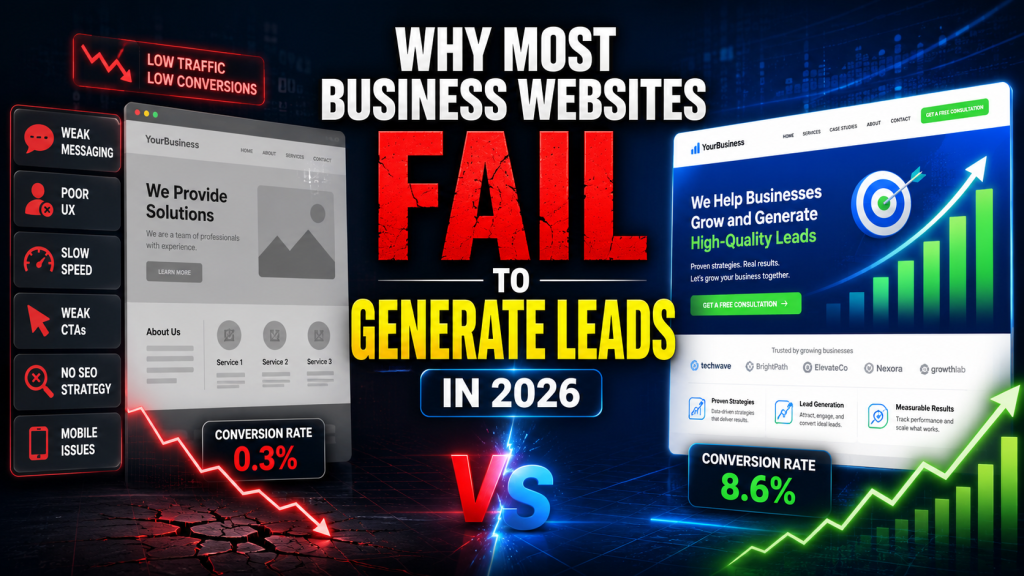
A business website can look modern, professional, and visually impressive while generating very few enquiries. This disconnect is one of the main reasons why business websites fail to produce meaningful commercial results.
Many businesses approach website development as a design project. They focus on colors, animations, photography, and branding but give less attention to messaging, user experience, search visibility, and conversion strategy.
Although visual design influences first impressions, a beautiful website is not automatically a high-converting website. If visitors cannot understand what the business offers, why they should choose it, or what they should do next, the design has failed to support the company’s goals.
A successful website must do more than represent a brand. It should attract relevant visitors, communicate value, build trust, answer important questions, and guide prospects toward an action. That action could be requesting a quotation, booking a consultation, making a purchase, calling the company, or submitting an enquiry.
In 2026, businesses face increased competition for attention. Customers can compare several providers within minutes. Therefore, companies need websites built around clarity, usability, speed, SEO, trust, and conversion.
This guide examines the most common business website mistakes and explains how to build a lead generation website that converts more visitors into qualified opportunities.
The Real Purpose of a Business Website
The purpose of a business website is not simply to establish an online presence. Its real purpose is to support measurable business growth.
An effective website should attract the right audience, explain the company’s value, establish credibility, and help potential customers take the next step. It should function as part of the company’s marketing and sales system rather than as a static digital brochure.
A conversion-focused web strategy begins with understanding the customer. Businesses need to know:
- Who their ideal customers are.
- What problems those customers need to solve.
- What information they require before making a decision.
- Which objections may prevent them from taking action.
- What type of conversion represents genuine business value.
Once these factors are clear, the website can be structured around the customer journey.
For example, a prospect may discover a company through a Google search, visit a service page, review a case study, read customer testimonials, and then request a consultation. Every page should help the visitor move naturally toward the next stage.
A high-performing website also serves different levels of buyer intent. Some visitors are ready to contact the business immediately. Others need educational content, proof of results, pricing information, or an explanation of the process before they feel confident enough to enquire.
Therefore, the website must combine branding with content, usability, SEO, conversion rate optimization, and performance tracking.
Common Reasons Business Websites Fail
Most underperforming websites do not have one isolated problem. Instead, several weaknesses work together to reduce traffic, engagement, and conversions.
A website may have unclear messaging, confusing navigation, slow performance, weak calls to action, and limited search visibility at the same time. Understanding these problems is essential when investigating why business websites fail.
Weak Messaging and Positioning
Visitors should be able to understand what a business offers within a few seconds of landing on its website.
However, many companies use vague statements such as “innovative solutions for modern businesses” or “your trusted partner for success.” These phrases may sound professional, but they do not clearly communicate the service, audience, problem, or outcome.
Strong website messaging should answer four immediate questions:
- What does the company provide?
- Who is the service intended for?
- What problem does it solve?
- Why should the visitor choose this company?
A clear value proposition should appear prominently near the top of the page. It should focus on the customer’s needs rather than beginning with the company’s history or achievements.
Positioning is equally important. If a website looks and sounds identical to every competitor, visitors may struggle to identify a meaningful difference. As a result, price may become the main basis for comparison.
Businesses can strengthen their positioning by highlighting their specialist experience, approach, industry knowledge, service standards, processes, or proven results. These claims should then be supported by evidence.
Poor UX Design
User experience, commonly known as UX, affects how easily visitors can navigate a website, find information, and complete an action.
Poor UX creates unnecessary friction. Common problems include complicated menus, crowded layouts, inconsistent page designs, confusing labels, intrusive popups, difficult forms, and important information hidden several clicks away.
Visitors should not have to work hard to understand a website. The design should help them answer practical questions such as:
- Am I in the right place?
- Does this company provide what I need?
- Can I trust this business?
- How does the service work?
- What should I do next?
Good UX uses a clear visual hierarchy. Important headings, benefits, proof, and calls to action should stand out. Content should be divided into readable sections, while navigation should remain predictable across the website.
Forms should also be easy to complete. Requesting unnecessary information can discourage visitors, particularly when they are making an initial enquiry.
Accessibility should be considered as part of UX design. Readable fonts, suitable contrast, descriptive links, keyboard-friendly navigation, and useful alternative text make the website easier for more people to use.
Slow Loading Speeds
A slow website can lose potential customers before they have an opportunity to understand the offer.
Large images, background videos, excessive animations, unnecessary plugins, third-party scripts, weak hosting, and poorly optimized code can all reduce loading speed.
Performance problems are especially noticeable on mobile devices and slower internet connections. A website that appears fast on a developer’s office computer may perform very differently for a customer using mobile data.
Slow pages can reduce engagement, interrupt forms, weaken advertising performance, and contribute to a poor overall user experience. They can also create technical SEO concerns.
Effective website conversion optimization must therefore include performance improvements. Businesses should compress images, use suitable file formats, enable caching, reduce unnecessary scripts, improve server response times, and test important pages regularly.
Visual effects should support the customer journey rather than delay access to the content.
Weak CTAs
A call to action, or CTA, tells the visitor what to do next. Examples include “Request a Quote,” “Book a Consultation,” “Call Our Team,” and “Start Your Free Trial.”
Many websites use CTAs that are too vague, difficult to find, or inconsistent. A button labeled “Submit” does not explain what will happen after it is clicked. Similarly, placing one small “Contact Us” link at the bottom of a long page may not provide enough direction.
Strong CTAs are specific and relevant to the page. For example, “Request Your Website Audit” is more descriptive than “Learn More.”
A lead generation website should also provide options for visitors at different stages of the decision-making process. A prospect who is ready to buy may choose “Request a Proposal,” while someone still researching may prefer “View Our Case Studies.”
The surrounding information can reduce uncertainty. Businesses should explain what happens after a form is submitted, when the visitor can expect a response, and whether the consultation involves any obligation.
CTAs should be noticeable without making the page feel aggressive. They should appear at logical points after the website has communicated enough value to justify the next step.
No SEO Strategy
Even a well-designed website cannot generate consistent leads if potential customers cannot find it.
Many businesses develop websites without researching keywords, search intent, competitors, customer questions, or technical SEO requirements. Consequently, their pages do not target the terms prospective customers use on Google.
A strong SEO strategy identifies the searches most relevant to the company’s services. It then creates pages that satisfy those search intentions.
Depending on the business, this may include:
- Detailed service pages.
- Industry or sector pages.
- Relevant location pages.
- Educational blog content.
- Comparison guides.
- Case studies.
- Frequently asked questions.
SEO is not limited to adding keywords to copy. Search engines must also be able to crawl, interpret, and index the website.
Technical problems involving canonical tags, redirects, broken links, XML sitemaps, structured data, mobile rendering, or page speed can restrict organic visibility.
The goal should not be to attract as many visitors as possible. Instead, SEO should attract people who are likely to need the company’s services. Relevant organic traffic is more valuable than high traffic with no commercial intent.
Mobile Optimization Issues
Mobile optimization involves much more than making a website fit a smaller screen.
A website may technically be responsive while still offering a poor mobile experience. Text may be difficult to read, buttons may be too close together, forms may require excessive typing, and important content may appear too far down the page.
Businesses should test the full customer journey on actual mobile devices. Menus, forms, buttons, images, popups, payment systems, and booking tools should all work correctly.
Mobile users may also have different priorities. They may want to call immediately, find directions, check opening hours, or request a quick quotation. These actions should be easy to access.
Phone numbers should be clickable, forms should use appropriate field types, and buttons should be large enough to select comfortably. Popups and sticky elements should not cover important content.
A mobile experience that creates frustration can reduce both enquiries and customer confidence.
How to Build a Website That Converts
Building a high-converting website requires an integrated approach to UX, conversion rate optimization, SEO, persuasive content, and trust.
The process should begin by defining clear conversion goals. Every important page should have a primary purpose. A homepage may direct visitors toward the right service, while a service page may encourage them to request a consultation.
Businesses should then map the customer journey. This involves identifying how prospects discover the company, what information they need, what objections they have, and what proof will help them make a decision.
Clear messaging should appear early on every major page. Visitors should not need to scroll through several sections before understanding the offer.
A strong service page will often include:
- A clear value proposition.
- The customer problems being addressed.
- Key benefits and outcomes.
- An explanation of the service.
- The company’s process.
- Testimonials or case studies.
- Frequently asked questions.
- A relevant call to action.
Trust signals are essential because visitors are often assessing risk. Useful trust elements include customer reviews, client logos, professional accreditations, team profiles, case studies, guarantees, transparent contact details, and clear privacy information.
Evidence should be specific. A case study showing the challenge, solution, and result is more persuasive than a general statement claiming that the company delivers excellent outcomes.
Forms should balance conversion volume with lead quality. A shorter form may generate more submissions, while a longer form may help qualify prospects. The correct approach depends on the complexity and value of the service.
SEO should also be incorporated from the beginning rather than added after development. Keyword research can guide page creation, while search intent can influence content structure. Internal links can connect educational content with commercial pages and help visitors continue their journeys.
Finally, conversion improvement should continue after launch. Businesses can test headlines, CTAs, layouts, form lengths, trust signals, and content order.
Changes should be based on evidence rather than personal preference. Analytics, user recordings, heatmaps, customer feedback, and sales data can reveal where visitors encounter problems.
Key Website Metrics Businesses Should Track
Website traffic alone does not indicate success. A website may attract thousands of visitors without generating qualified opportunities.
Businesses should track metrics that connect website activity with commercial performance.
Bounce Rate
Bounce rate can help identify pages where visitors leave without meaningful interaction.
A high bounce rate may be caused by irrelevant traffic, slow speed, weak messaging, poor mobile usability, or a mismatch between the search result and landing page.
However, bounce rate should not be assessed alone. Some visitors may find the information they need without visiting another page. Businesses should review bounce rate alongside conversion, engagement, traffic source, and search intent.
Conversion Rate
Conversion rate measures the percentage of visitors who complete a desired action.
Businesses should track primary conversions, such as quotation requests or purchases, separately from secondary conversions, such as downloads or newsletter subscriptions.
Conversion rates should also be reviewed by page, device, marketing channel, and campaign. This makes it easier to identify where optimization could produce the greatest impact.
Session Duration and Engagement
Session duration and engagement data can indicate whether visitors are interacting with the website’s content.
Low engagement on a major service page may suggest that the messaging is unclear or that the page does not meet visitor expectations.
However, a longer session is not automatically positive. Visitors may remain on a website because information is difficult to locate. Engagement data should therefore be interpreted alongside conversions and navigation behavior.
Lead Quality
Lead quality is one of the most important website metrics.
A website may produce many enquiries while attracting people with the wrong budget, location, requirements, or expectations. Therefore, businesses should connect website data with sales results.
Useful lead-quality metrics include:
- Cost per qualified lead.
- Percentage of leads accepted by sales.
- Appointment or proposal rate.
- Closing rate by traffic source.
- Average customer value.
- Revenue generated through the website.
- Common reasons leads are rejected.
Tracking lead quality helps businesses identify which pages, keywords, and campaigns generate genuine commercial value rather than empty enquiry volume.
Other useful metrics include form abandonment, CTA clicks, returning visitors, call volume, organic landing-page performance, page speed, and conversion value.
Conclusion
Understanding why business websites fail begins with recognizing that a website is not only a design asset. It is a marketing, sales, communication, and lead generation system.
Beautiful visuals can support a positive impression, but they cannot replace clear positioning, persuasive messaging, strong UX, fast loading, mobile usability, effective CTAs, and a complete SEO strategy.
A successful lead generation website attracts the right audience, communicates value quickly, builds confidence, removes friction, and makes the next step obvious.
Businesses should also measure what happens after launch. Conversion rates, engagement, lead quality, and sales outcomes provide the information needed to improve performance continuously.
By correcting these common business website mistakes and investing in structured website conversion optimization, companies can transform their websites from passive online brochures into valuable growth assets.
Need a high-converting business website? Work with DGTECH today. DGTECH can help you plan, design, develop, and optimize a professional website built to attract qualified traffic and convert more visitors into genuine business opportunities.