

Search Engine Optimization (SEO) is the process of improving your website’s visibility on search engines like Google. It helps your business appear higher in search results when potential customers look for products or services related to what you offer.
In today’s digital age, having a website isn’t enough, it needs to be discoverable. That’s where SEO comes in. By optimizing your content, structure, and overall website performance, SEO helps attract organic traffic, build brand credibility, and establish long-term growth without relying solely on paid ads.
What is On-Page SEO?

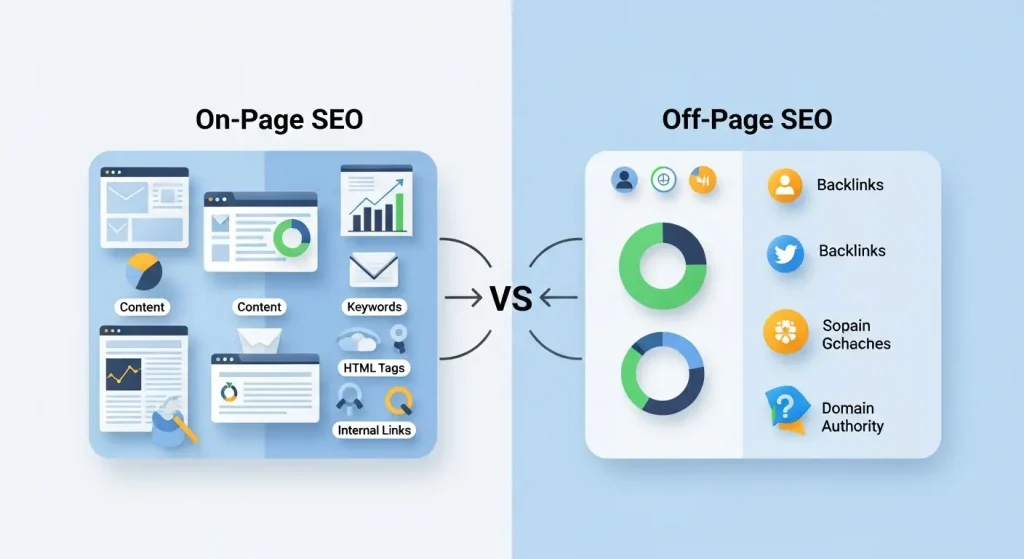
On-page SEO is the process of optimizing elements within your website, such as content, structure, and keywords, to enhance visibility and improve rankings on search engines. It focuses on making your site easy to understand for both users and search engines.
Core Elements of On-Page SEO
- Keyword Optimization: Using relevant keywords naturally in titles, headings, and content.
- Meta Tags: Writing clear and attractive meta titles and descriptions.
- Content Quality: Publishing original, valuable, and well-structured content.
- URL Structure: Keeping URLs short, descriptive, and easy to navigate.
- Internal Linking: Connecting related pages to guide users and search engines.
- Image Optimization: Adding alt text and compressing images for faster load times.
Benefits of On-Page SEO
- Better Search Rankings: Well-optimized pages have a higher chance of appearing on the first page of Google.
- Improved User Experience: Easy navigation, fast loading, and quality content keep visitors engaged.
- Increased Organic Traffic: More visibility means more visitors finding your website naturally.
- Higher Conversion Potential: Targeted keywords bring in users who are genuinely interested in your products or services.
Best Practices for On-Page SEO
- Use primary and secondary keywords naturally throughout your content.
- Optimize headings (H1, H2, H3) for clarity and relevance.
- Keep your website mobile-friendly and ensure fast loading times.
- Regularly update and refresh your content to stay relevant.
- Use structured data (schema markup) to enhance how your pages appear in search results.
What is Off-Page SEO?

Off-page SEO refers to all the activities conducted outside your website to enhance its authority, credibility, and visibility on search engines. These activities, often included in professional SEO Services, help search engines see your website as trustworthy and valuable through external signals such as backlinks and brand mentions.
Core Elements of Off-Page SEO
- Backlink Building: Earning links from reputable and relevant websites to build authority.
- Social Media Marketing: Promoting your brand and content across social platforms to boost engagement and traffic.
- Guest Blogging: Writing articles on other websites to reach new audiences and gain backlinks.
- Influencer Collaboration: Partnering with influencers or industry leaders for brand exposure.
- Online Reviews & Mentions: Encouraging positive reviews and mentions on external sites to strengthen credibility.
Benefits of Off-Page SEO
- Improves Domain Authority: High-quality backlinks signal to search engines that your website is reliable.
- Boosts Search Rankings: The more trustworthy your site appears, the higher it can rank.
- Increases Referral Traffic: External links bring new visitors from other sites.
- Enhances Brand Visibility: Builds recognition and reputation across multiple platforms.
Best Practices for Off-Page SEO
- Focus on earning backlinks from relevant, high-authority sources.
- Avoid spammy or paid link schemes.
- Maintain consistent branding across all social and online profiles.
- Engage actively with audiences on forums, communities, and social platforms.
- Monitor your backlink profile regularly and disavow harmful links.
Key Differences Between On-Page and Off-Page SEO

Comparison of Strategies
While both On-Page and Off-Page SEO aim to improve your website’s visibility, they focus on different aspects of optimization.
| Aspect | On-Page SEO | Off-Page SEO |
|---|---|---|
| Focus | Optimizing content and structure within your website | Building authority and reputation outside your website |
| Control | Completely under your control | Influenced by external sources (e.g., backlinks, mentions) |
| Goal | Improve relevance and user experience | Improve credibility and domain authority |
| Methods | Keyword usage, meta tags, internal links, and content optimization | Link building, guest posts, and social media engagement |
| Measurement | Based on content quality and site performance | Based on backlinks, brand mentions, and online reputation |
Impact on Rankings
On-Page SEO ensures search engines understand your content and rank it accurately based on relevance. Off-Page SEO, on the other hand, signals how trustworthy and popular your website is.In short:
- Strong On-Page SEO helps you appear in search results.
- Effective Off-Page SEO helps you climb higher in those results.
- When combined, both create a powerful synergy that drives better rankings and sustainable traffic growth.
Examples of Each Approach
On-Page SEO: Writing keyword-optimized blog posts, improving page load speed, adding internal links, and optimizing images.
Off-Page SEO: Getting backlinks from authority sites, promoting content on LinkedIn or Facebook, and earning positive Google reviews.
How On-Page and Off-Page SEO Work Together

On-Page and Off-Page SEO are two sides of the same coin. On-Page SEO ensures your website is optimized, fast, and full of valuable content, while Off-Page SEO builds credibility and trust through backlinks and brand mentions.
Why You Need Both
On-Page and Off-Page SEO complement each other to create a complete and effective digital strategy. On-Page SEO ensures your website is optimized internally fast, user-friendly, and content-rich while Off-Page SEO builds your credibility and authority externally.
Think of On-Page SEO as building a strong foundation for your house, and Off-Page SEO as building your reputation in the neighborhood. Without one, the other won’t have the same impact. A perfectly optimized website won’t rank well without backlinks and trust signals, and strong backlinks won’t help if your content or structure is poor.
When both work together, they enhance each other’s effectiveness, resulting in higher rankings, more consistent traffic, and stronger brand authority.
Balancing Your SEO Strategy
A successful SEO strategy focuses on both aspects equally. Start with solid On-Page optimization, keyword-rich content, meta tags, and technical performance. Then, build your Off-Page efforts by earning quality backlinks, engaging on social media, and managing your online reputation.
Consistency is key. Regularly update your content, track your website performance, and continue strengthening your external presence. Over time, this balance will lead to steady growth, better rankings, and sustainable online visibility.
Common Mistakes to Avoid

When implementing SEO, even small missteps can limit your results. Many businesses focus on one side of SEO while neglecting the other, or overlook technical and strategic details that affect performance. Avoiding common mistakes is key to maintaining strong rankings and steady growth. Below are some of the most frequent On-Page and Off-Page SEO errors to watch out for.
On-Page SEO Errors
Even small mistakes can hurt your SEO performance. Some of the most common On-Page SEO errors include:
- Keyword Stuffing: Overusing keywords unnaturally in content.
- Duplicate Content: Reusing the same content across multiple pages.
- Slow Loading Speed: Not optimizing images or code for faster performance.
- Missing Meta Tags: Skipping meta titles and descriptions that help with ranking.
- Poor Mobile Experience: Ignoring mobile optimization, which affects user experience and rankings.
Off-Page SEO Errors
Off-Page SEO mistakes often come from poor link-building or reputation management. Key errors to avoid are:
- Buying or Spamming Backlinks: Low-quality links can harm your site instead of helping.
- Ignoring Online Reputation: Negative reviews or lack of mentions can affect trust.
- Inconsistent Branding: Using different names or visuals across platforms weakens recognition.
- Neglecting Social Engagement: Not promoting or sharing your content reduces visibility.
- Focusing on Quantity Over Quality: A few high-quality backlinks are far more valuable than many low-quality ones.
FAQs on On-Page vs Off-Page SEO

Understanding the difference between on-page and off-page SEO can be confusing, especially for beginners. To help you get a clearer picture, here are some of the most frequently asked questions about how these two SEO strategies work and how they impact your website’s ranking.
What’s More Important: On-Page or Off-Page SEO?
Both are equally important. On-page SEO helps search engines understand your content, while off-page SEO builds your website’s credibility and authority. A strong ranking strategy needs a balance of both.
How Long Does It Take to See Results?
SEO results typically take 3 to 6 months, depending on your competition, content quality, and consistency. On-page changes may show quicker results, while off-page improvements take longer to reflect.
Can You Rank Without Off-Page SEO?
It’s possible to rank for low-competition keywords with only on-page SEO, but for competitive searches, off-page SEO, especially backlinks, is essential to boost your authority and visibility.
Conclusion
Both on-page and off-page SEO play vital roles in achieving higher search rankings and driving organic traffic. On-page SEO focuses on optimizing the content and structure of your website, while off-page SEO builds trust and authority through external efforts like backlinks and brand mentions.
To succeed in today’s competitive digital space, businesses must maintain a balanced SEO strategy, ensuring their website is both search-friendly and trusted by others online. Consistency, quality content, and ethical practices remain the keys to long-term SEO success.